The 2021 Washington Wildland Urban Interface (WUI) Code, set to take effect in March of 2024, has evoked concerns from multiple sectors, including builders and environmentalists. The US Fire Administration defines WUI as “ the zone of transition between unoccupied land and human development. It is the line, area, or zone where structures and other human development meet or intermingle with undeveloped wildland or vegetative fuels.” Considering the urban sprawl into undeveloped areas and the open spaces integrated into metropolitan areas, the new code may require changes in large cities, including Seattle, Tacoma, and Olympia.
Adopted from the International WUIC, the Washington version includes several guidelines that are unclear or open to interpretation. First, the code requires fire-resistant materials for vulnerable parts of new or remodeled buildings, both commercial and private. Depending on the location and type of building and the higher cost of fire-resistant materials, these requirements will increase the cost of a new or remodeled home. Second, a defensible space from 30 to 100 feet is required between buildings and vegetation based on several factors, such as firefighting access and building materials. If the code requires a home to implement a 30-foot buffer between plants and buildings, homeowners may be required to remove most if not all, trees and landscaping on their property. Given that cities have begun to focus on tree canopy as a strategy for addressing climate change and equity, the code may be at odds with local policies.
Additionally, the new code is based on WUI maps adopted in 2019 that include forests, grasslands, and other vegetated areas with more than 50% burnable cover. The following map of Pierce County, taken from the Wildland-Urban Interface StoryMap, illustrates the WUI that may trigger significant defensible space modifications for homes and businesses. Concerns about the maps include the different threats to wildfire across the state and a questionable depiction of wildfire risk (not aligned with FEMA fire risk assessment maps).
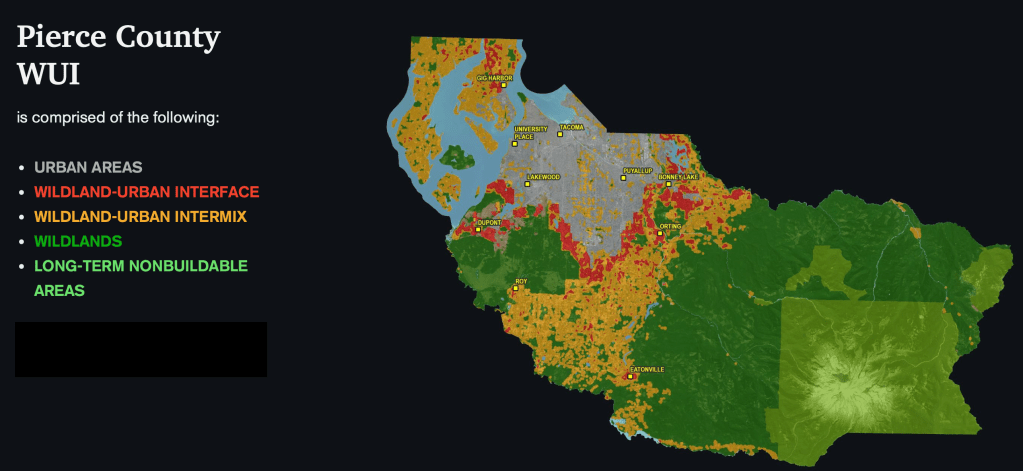
Many believe that the WUIC has enough ambiguous, unclear, or unenforceable requirements that it should not be implemented without changes. The state legislature – if there is a call from builders, municipalities, and citizens- can make changes to the code when the next legislative session starts in January 2024.
- Articles
- Embracing Safety: Washington WUI Code Update 2023, Eric Peterson, Lexar Homes – https://www.lexarhomes.com/washington-wui-code-update-2023/
- New rules to protect homes from wildfire ignite controversy, Washington State Standard – https://washingtonstatestandard.com/2023/10/30/new-rules-to-protect-homes-from-wildfire-ignite-controversy/
- What is the WUI?! Learn about the Wildland-Urban Interface code, Building Industry Association of Washington – https://www.biaw.com/wildland-urban-interface/
- Urban Trees in Western Washington – A Wildfire Risk? Charlotte Persons, Black Hills Audubon – https://blackhills-audubon.org/urban-trees/
- Resources
- Washington State’s Wildland Urban Interface (WUI) Map (WA Department of Natural Resources) – A searchable statewide interactive map depicting Wildland Urban Interface designation
- State Rule Making Order
- ICC Base Code Language
- UPCODES base language
 cloverchamberscreekwatershedcouncil.blog