Continued growth and urban sprawl throughout the Chambers-Clover Creek Watershed, and Pierce County in general, is aligned with a persistent challenge: more trash. Municipalities, Pierce County, and private services help manage the solid waste generated by residents, businesses, and public services; however, a walk through a neighborhood, park, or city street reveals trash – everywhere. Historically, cities formed because of centralized trade, access to goods, services, education, and economic opportunities. Today, approximately 80% of the US population lives in urban areas, defined by the US Census Bureau as “densely developed residential, commercial, and other nonresidential areas.” In 1990, Washington passed the Growth Management Act (GMA) to address accelerating development and growth. In 2023, the legislature passed changes to the GMA, focusing on housing, climate change, and environmental justice DMA changes included exemptions for residential and middle housing projects, shoreline management, and clean energy mitigation and siting. All of the changes will have an impact on continued urban density and more solid waste.
The higher the population density, the higher the amount of urban waste (Voukkali et al., 2024). However, due to the concentration of services (including utilities, mass transportation, and multi-family housing), there is evidence that energy use is reduced in urban areas. However, water use and trash production are calculated on an individual level; thus, trash and water consumption increase with each person in a city, impacting our watershed.
There are multiple challenges regarding trash and watershed quality. Toxic materials from roadways are flushed into waterways, and waste is dumped or makes its way into low-lying creeks or dry beds (Hamilton, 2023). Single-use materials (packaging, disposable goods, etc.) are particularly prolific and susceptible to the disintegration of synthetic materials, which then enter and polluting water tables. Municipality waste management is a small piece of how trash is handled. Much, if not most, trash in the environment comes from non-residential or commercial generation discarded materials in public or open spaces.
What can you do?
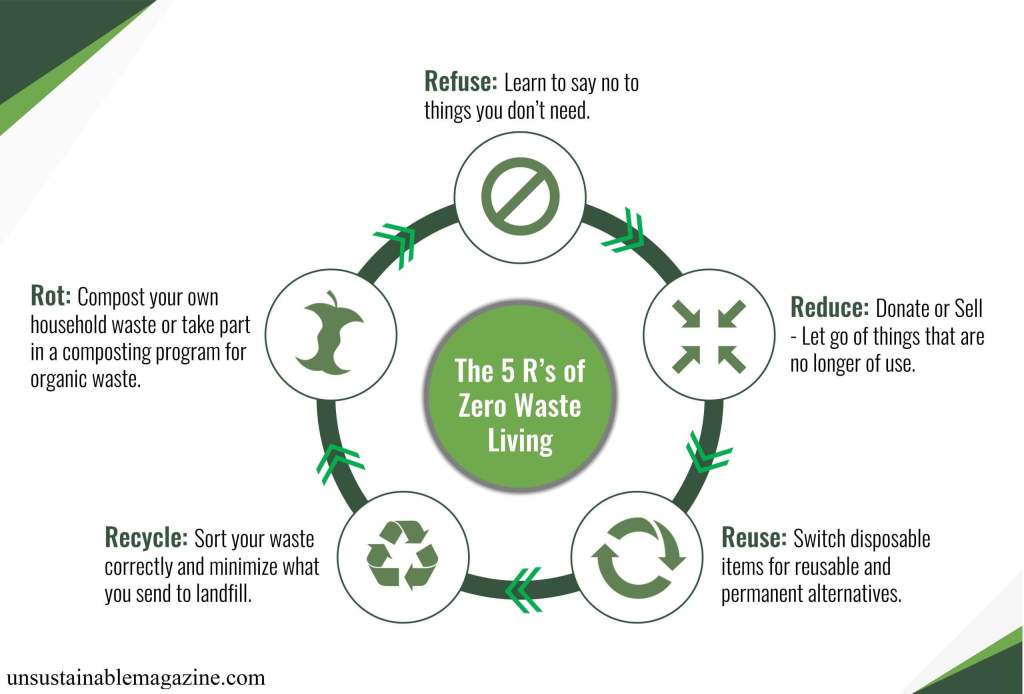
First familiarize yourself with the 5 Rs.
In your Community
- Pick up trash. Take a bag with you on a walk, errand trip, between work meetings, attending events, etc.
- Join a creek work party. Many groups sponsor cleanup activities. Check Communities for a Healthy Bay, Pierce Conservation District (includes events hosted by multiple organizations), Lakewood, Puyallup Adopt-a-Trail Program, and other groups in your area.
- Attend a home and garden workshop. Many workshops focus on reducing waste, reusing materials, and preventing pollution. You will also meet others interested in reducing waste and protecting the environment.
In your Life
- Try to follow the 5 R’s. The following graphic illustrates five ways we can rethink what we use to buy and keep and how to get rid of things that are no longer needed.
- Consider packaging when making a purchase. For example, bring reusable produce bags when you shop rather than use paid plastic bags. If produce is pre-packaged, request that it not be – most stores will allow you to buy a portion of a pre-packaged bulk item.
In your Residence
- Recycle as much as possible from home. Not sure what can be recycled? See the Pierce County Recycling Menu.
- Avoid pouring toxic materials into your drains. Public water systems cannot remove all toxic materials, particularly drugs, which can end up in the watershed, harming wildlife and re-entering our drinking water. See Pierce County Prescription Drug Disposal.
- Fire stations often accept toxic materials, medicine, and other materials that are hard to dispose of; see West Pierce Fire Rescue.
- Use Municipal and County transfer stations for hard-to-dispose materials. Check out the Pierce County Transfer Stations directory.
- Distinguish between trash and what might be used for another purpose by an organization or can be given away. Donate and purchase used materials – one person’s trash can be someone else’s treasure!
- Smarter: How to Throw Out Stuff You Don’t Need
- Pierce County Freecycle
- Buy Nothing
- Pierce County Reuse and Salvage services
- Ridwell – This subscription-based service takes hard-to-recycle materials, including double-layered plastic (e.g., chip bags), plastic bags, batteries, light bulbs, and much more. Even better, they have a market for the materials they collect so you are guaranteed they do not go into a landfill
- Half Price Books – HPB makes efforts to donate books to schools and non-profit organizations globally and recycles materials that cannot be resold.
In your Workplace
- Encourage or start assortment bins for recycling, compost, trash, etc.
- Encourage reusable water bottles for drinks.
- Encourage reusable food containers.
- Reuse single-sided paper printouts.
References
Hamilton, J. D., (2023). Trashed: A review of anthropogenic litter in an urban watershed. Water Resources Science and Technology Theses and Graduate Research Reports. 6.
https://digitalcommons.tamusa.edu/water_theses/6/#:~:text=Urban%20creeks%2C%20streams%20and%20rivers,tarnishes%20an%20otherwise%20unscathed%20ecosystem
National Geographic Education The history of cities. https://education.nationalgeographic.org/resource/history-cities/
US Census Bureau. (2022). Nation’s urban and rural populations shift following 2020 Census. Press Release Number CB22-CN.25. https://www.census.gov/newsroom/press-releases/2022/urban-rural-populations.html#:~:text=Despite%20the%20increase%20in%20the,down%20from%2080.7%25%20in%202010
Voukkali, I., Papamichael, I., Loizia P., Zorpas, A. A. (2024). Urbanization and solid waste production: Prospects and challenges. Environmental Science Pollution Restoration International 31(12), 17678-17689. https://doi.org/10.1007/s11356-023-27670-2.
Washington State Department of Commerce. (2023). Planners’ newsletter on legislative changes in 2023. https://content.govdelivery.com/accounts/WADOC/bulletins/35d5860
 cloverchamberscreekwatershedcouncil.blog