On May 15, 2024, at the monthly CCWC meeting, four tree advocates and experts discussed their work and recommendations for improving tree canopy and health in Pierce County. The speakers were Ryan Hebert, Urban Forest Analyst, City of Tacoma Office of Environmental Policy and Sustainability; Michael Liang, Policy Advisor, Washington Department of Natural Resources; Dr. Christina Mannetti, President, The Garry Oaks Coalition; and. Lowell Wyse, Executive Director, Tacoma Tree Foundation. The following summarizes the panel discussion.
Why are trees and canopy necessary? Trees provide economic, environmental, and health benefits to society (see The Value of a Tree). They are essential to the quality of life for all living creatures. They assist with carbon sequestration, act as a noise buffer, and provide biodiversity to sustain the local ecosystem. Moreover, the Center for Watershed Protection informs us that urban tree canopy (UTC) “provides an important stormwater management function by intercepting rainfall that would otherwise run off of paved surfaces and be transported into local waters through the storm drainage system, picking up various pollutants along the way. UTC reduces the urban heat island effect, heating/cooling costs, lowers air temperatures, reduces air pollution, increases property values, provides wildlife habitat, and provides aesthetic and community benefits such as improved quality of life.” Caring for and preserving trees, particularly mature trees, helps everyone benefit.Achieving equitable and functional tree canopy can be challenging. For many cities, urban forests that provide the most significant collective canopy are located in parks or only certain parts of a town, as seen in the image below of Tacoma’s tree canopy in 2018. The more comprehensive the canopy spread, the greater its benefits. Efforts from municipalities, organizations, and individuals are essential. The goal is to spread the canopy to all neighborhoods, not just a few.
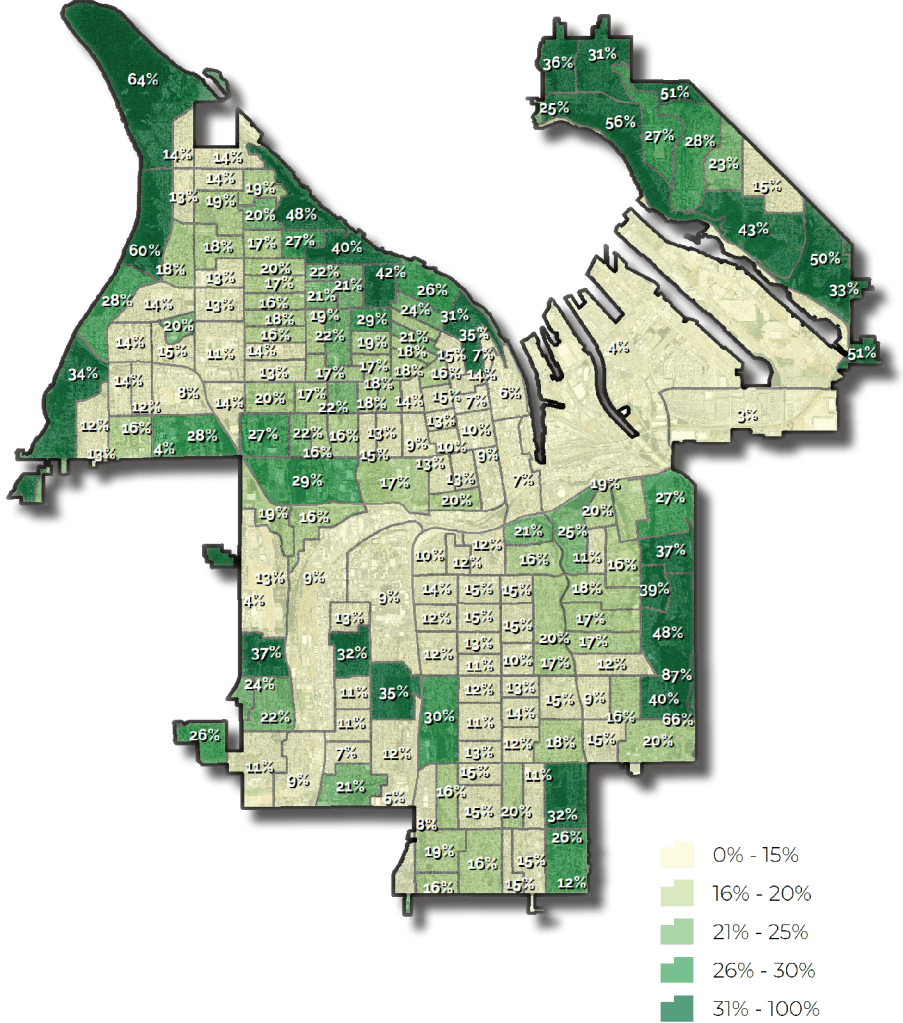
How does urbanization affect the viability of trees and their collective canopy? As detailed in The Prairie Post, the 2020 Census indicates that most growth has been and continues to be in unincorporated Pierce County. As the development of private property expands, so does the likelihood of tree removal and density. There are many challenges for trees and forests in urban and increasingly developed Pierce County, including:
- Impervious surface (pavement, concrete, roads, buildings, etc.) prevents water absorption through tree roots and restricts the spread of the tree’s root system.
- Tree canopy benefits cross municipal and geographical boundaries, making it hard for the County to adopt successful practices. Lowell Wyse, with Pierce County Health Department, produced a summary of tree policies across cities illustrating the variance between jurisdictions.
- Tree preservation, protection, and propagation policies typically apply to public or commercial properties; residential or other private properties may not be included in tree codes that can be hard to enforce as cities rely on citizen reporting for most violations. There are some models for expanding the canopy. Ryan Herbert noted Renton’s Urban and Community Forestry as an example of how cities can extend the protection of trees.
- Mitigation strategies that rely on planting new trees for those removed are limited in effectiveness. Depending on the species, trees may take 10-20 years to reach maturity and even longer to yield benefits. The more mature trees have better carbon sequestration and produce larger, thus more efficient tree canopy. Yet mature trees are typically the ones removed for development.
The 2024 County Comprehensive Plan Periodic Review addresses growth management for specific Critical Areas for which the County seeks your input. The Land Use Advisory Commission meeting on Community Plan updates will occur over the 2024 summer.
What do advocates and experts propose?
Follow the examples and lessons learned from others.
- Tacoma’s tree canopy story
- Tacoma’s Urban Forest Management Plan, adopted in 2019
Join existing programs as an individual or an organizational representative.
- WA State Tree Equity Collaborative strives to ensure that trees and their canopy are a part of all parts of a community. The goal is to score 75% or higher in urban areas on the Tree Equity Score
- The Department of Natural Resources Urban and Community Forest Program “works to educate citizens and decision-makers about the economic, environmental, psychological and aesthetic benefits of trees and to assist local governments, citizen groups and volunteers in planting and sustaining healthy trees and vegetation wherever people live, work and play in Washington state. The mission is to provide leadership to create self-sustaining urban and community forestry programs that preserve, plant and manage forests and trees for public benefits and quality of life.”
Support and join efforts to plant and maintain trees.
- Promote and support tree giveaways and directions about planting and caring for newly planted trees for at least three to five years. Ideally, trees should be native, healthy, pest- and drought-resistant. Moreover, instructions about where to plant a tree are critical -they need room to grow and should not be constricted by human-made structures. For example, one keystone tree in our area is the Douglas Fir conifer, an evergreen that withstands environmental changes and stressors. However, it can reach 125’ tall and 30’ wide at its base and take 10 to 20 years to mature; thus, we should select the right tree for the right place. Check out Seattle’s guide to Tree Selection.
- Participate in restoration programs. Many opportunities are offered through Pierce Conservation District, Pierce County Parks and Recreation, and other groups committed to improving habitat. By helping plant and restore tree habitats, you will learn how to care for your trees. Check out Pierce County’s advice for tree planting.
 cloverchamberscreekwatershedcouncil.blog